Photography Composition Angles: Leading Lines, Tilt, and Perspective
When you look at a professional photograph, your eye naturally moves to the subject. This doesn't happen by accident. The photographer used geometry—specifically lines and angles—to direct your gaze.
Angles are one of several tools that shape a photograph. Here is how to use them deliberately while remembering that a visually strong angle is not always the same thing as a mathematically exact angle in the real scene.
Before You Shoot: Separate Visual Effect from Exact Measurement
In a photo, the angle you feel can be heavily influenced by perspective, lens choice, camera height, and cropping.
- A wide lens can exaggerate diagonal lines.
- Shooting from very close can make lines feel more dramatic than they really are.
- Cropping can remove the level horizon that originally balanced the frame.
That is why photographers often make composition decisions by eye first, then verify with tools only when precision really matters.
1. Leading Lines: The Arrow in the Frame
Leading lines are lines within an image that lead the eye to another point in the image.
- Converging Lines: Think of a road or railroad tracks disappearing into the distance. The angle formed by these lines creates a sense of depth (perspective).
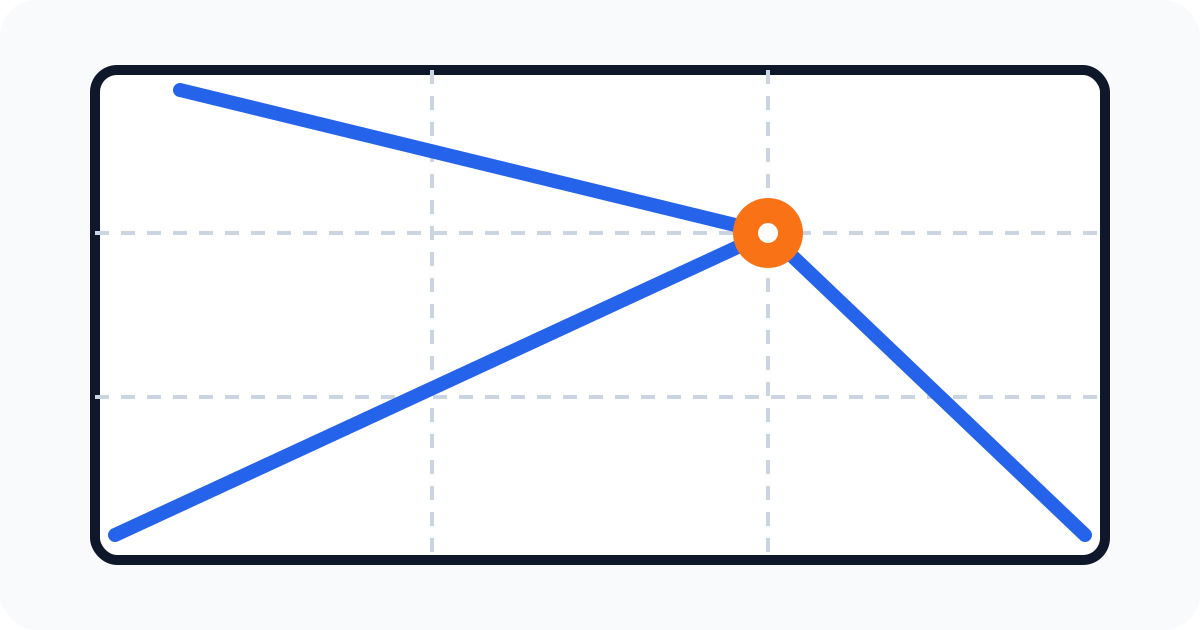
- The V-Shape: If you position your subject at the vertex of a "V" shape (like a valley between mountains), the viewer's eye is forced directly to it.
2. Perspective: High vs. Low Angles
The angle at which you hold your camera changes the psychological feeling of the photo.
- Low Angle (Worm's Eye View): Shooting from the ground up makes the subject look powerful, dominant, and heroic. The lines of the subject (like a person or building) appear to converge towards the sky.
- High Angle (Bird's Eye View): Shooting from above makes the subject look smaller, vulnerable, or part of a larger pattern.
- Eye Level: This is the most neutral angle. It feels honest and direct, like a conversation.
If you are testing several viewpoints, take a quick sequence from low, eye-level, and high positions before choosing the final frame. Small camera-height changes often matter more than beginners expect.
3. The "Dutch Angle" (Dutch Tilt)
Most photos are taken with the horizon perfectly horizontal (0 degrees). But what happens if you tilt the camera?
- The Technique: A "Dutch Angle" involves tilting the camera axis by roughly 15 to 30 degrees.
- The Effect: This destroys the stability of the image. It creates a sense of unease, tension, disorientation, or dynamic action. You see this constantly in horror movies or action scenes (like the old Batman TV show).
- When to Use It: Use it sparingly. A slight tilt can make a car look faster or a villain look crazier. Overuse it, and your viewer will just get a headache.
One common mistake is adding a tilt when the scene is already busy. If the frame already has strong diagonals, motion blur, or crowded details, more tilt may make the photo feel messy instead of intentional.
4. Triangles: The Strongest Shape
Triangles are powerful in composition because they are dynamic but stable.
- Implied Triangles: You can form triangles by posing a group of three people, or by arranging objects on a table.
- The Golden Triangle: This is a rule of composition where you divide the frame with a diagonal line from corner to corner, then draw two lines from the other corners to meet it at 90-degree angles. Placing your subject at these intersections creates a harmonious, energetic balance.
A Simple Composition Workflow
When you are unsure whether an angle improves the image, use a repeatable workflow:
- Start with a neutral, level frame.
- Move higher or lower before you start tilting the camera.
- Check whether the main lines actually lead to the subject.
- Shoot one version with a stronger angle and one version with less exaggeration.
- Compare them afterward instead of trusting the first dramatic result.
This helps you avoid confusing novelty with good composition.
Common Reasons an Angle-Based Photo Fails
Photos built around angles often fail because:
- the background contains distracting lines that fight the subject,
- the horizon looks accidentally crooked instead of intentionally tilted,
- perspective distortion makes people or products look unnatural,
- or the crop cuts off the line that was supposed to guide the eye.
When that happens, the problem is often not the idea itself, but the execution.
When Should You Verify with a Tool?
Visual judgment is usually enough for expressive photography, but it helps to verify with a tool when:
- you are photographing architecture or interiors,
- you need a product shot to look level and clean,
- you are matching angles across several images in the same project,
- or you want to compare a visual angle with a real measured one.
For those cases, our Online Protractor can help you inspect screenshots, and estimate angles without tools gives a good mental reference for fast judgment.
Worked Example: Reviewing a 17° Horizon Tilt
Imagine two edits of the same street photograph. One is level; the second was intentionally rotated until the horizon appears about 17° from horizontal.
- Export the edited image without changing its aspect ratio.
- Upload it to the Online Protractor.
- Put the center on a clear point along the horizon or another reliable level reference.
- Place one ray horizontally and the second along the visible reference line.
- Repeat at another part of the same line to check that lens distortion or a curved horizon is not changing the result.
| Review question | Observation | Action |
|---|---|---|
| Is the tilt deliberate? | About 17° and visually obvious | Keep if tension supports the story |
| Does the subject lean unintentionally? | Vertical architecture also looks unstable | Compare with a smaller rotation |
| Do repeated placements agree? | Results vary by more than 1° | Use a longer, clearer reference line |
The measured value describes the exported image. It does not reconstruct the camera's physical orientation or the three-dimensional scene. For the distinction between display resolution and source accuracy, see the measurement accuracy guide.
Conclusion
Next time you pick up your camera or phone, don't just point and shoot. Look for the lines. Crouch down. Climb up. Tilt the horizon with intention. You aren't just taking a picture; you are arranging geometry to tell a story.
If you want another real-world angle reference, connect this topic with geometry in architecture to see how built spaces influence the lines you photograph.
Sources and references
- How to use leading lines in photography — Adobe
- Learn photography — Nikon