Understanding Angles: A Complete Guide to Types and Classifications
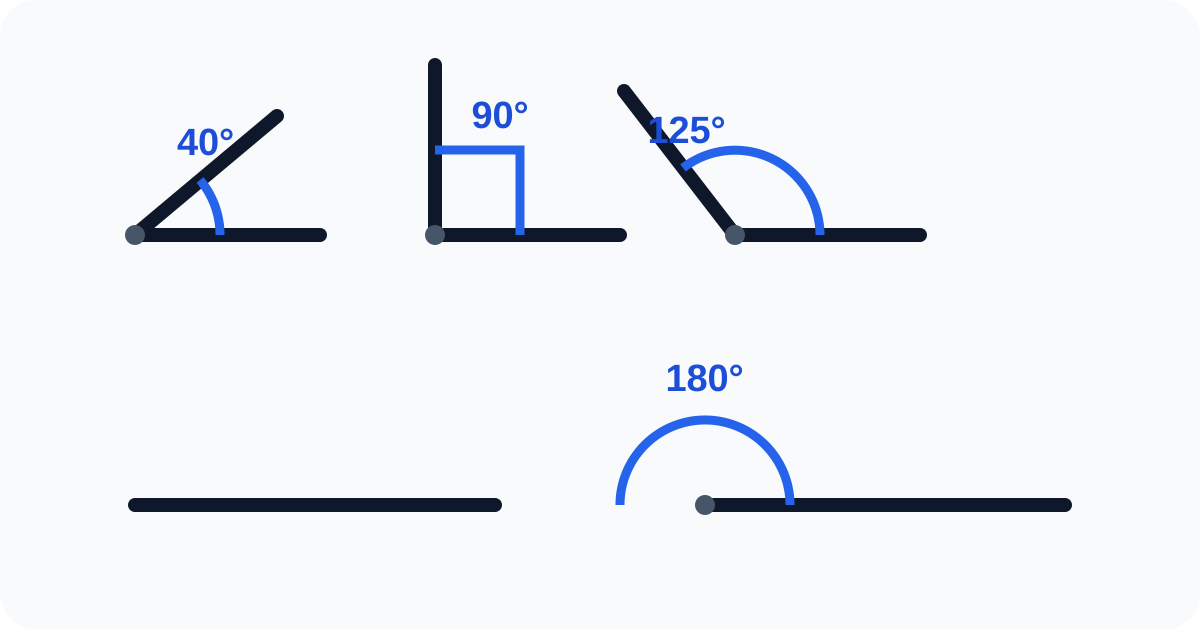
Angles are everywhere around us. From the corners of your room to the hands of a clock, angles help us describe the shape and structure of our world. But in geometry, not all angles are created equal. Understanding how to classify them is the first step in mastering measurement. It also helps you decide when an angle is obviously small, when it is close to a right angle, and when you should stop guessing and measure carefully.
In this guide, we'll break down the fundamental types of angles, how to identify them, and how to measure them accurately using tools like our Online Protractor.
What is an Angle?
Before we dive into the types, let's define what an angle actually is.
In geometry, an angle is formed when two rays (lines that start at a point and go on forever in one direction) meet at a common endpoint. This endpoint is called the vertex.
- Vertex: The point where the two rays meet.
- Arms: The two rays that form the angle.
- Measure: Usually measured in degrees (°), representing the amount of turn between the two arms.
The 5 Main Types of Angles
Angles are classified based on their size (in degrees). Here are the five main categories you need to know:
1. Acute Angle (Less than 90°)
Think of "acute" as "small" or "sharp." An acute angle measures greater than 0° but less than 90°.
- Visual: Like a slice of pizza or the tip of a sharp pencil.
- Example: The letter 'V' or a partially open pair of scissors.
2. Right Angle (Exactly 90°)
The most common angle in construction and design. A right angle measures exactly 90°.
- Visual: The corner of a square or rectangle. It looks like a perfect "L".
- Symbol: In diagrams, a right angle is often marked with a small square at the vertex.
- Example: The corner of a book, a computer screen, or where a wall meets the floor.
3. Obtuse Angle (Between 90° and 180°)
"Obtuse" means blunt or wide. These angles are larger than a right angle but smaller than a straight line.
- Visual: Like a reclining beach chair or a clock showing 4 o'clock.
- Example: The angle of a roof on a house (often obtuse to shed rain).
4. Straight Angle (Exactly 180°)
A straight angle looks exactly like a straight line. It measures exactly 180°.
- Visual: A flat surface.
- Example: A pencil lying flat on a desk, or the horizon.
5. Reflex Angle (Greater than 180°)
These are the "big" angles that bend back on themselves. A reflex angle measures more than 180° but less than 360°.
- Visual: Think of Pac-Man with his mouth open wide. The angle outside his mouth is the reflex angle.
- Example: When you open a laptop screen past flat (if the hinge allows).
Where You See These Angle Types in Real Life
Angle classification becomes more useful when you connect it to tasks outside a textbook.
- Acute angles often appear in arrows, roof bracing, scissors, and narrow corners in diagrams.
- Right angles are common in rooms, screens, paper, tiles, and many construction layouts.
- Obtuse angles show up in wide-opening doors, furniture joints, and sloped shapes viewed from the inside.
- Straight angles appear when two arms form a single line, such as a flat hinge or a horizon reference.
- Reflex angles matter when you need the larger turn, such as rotation in a diagram, a sweeping arm movement, or the outside angle around a shape.
Recognizing these patterns quickly is helpful in classroom geometry, design sketches, architecture, and image-based measurement tasks.
Summary Table
| Angle Type | Measurement (Degrees) | Key Feature |
|---|---|---|
| Acute | 0° < x < 90° | Sharp, small |
| Right | x = 90° | Perfect "L" corner |
| Obtuse | 90° < x < 180° | Wide, open |
| Straight | x = 180° | Straight line |
| Reflex | 180° < x < 360° | Bends back |
How to Measure Angles
Knowing the types is great, but measuring them is where the real skill lies. Traditionally, you would use a plastic or metal protractor.
- Place the center point of the protractor on the vertex of the angle.
- Align the baseline of the protractor with one of the angle's arms (at 0°).
- Read the number on the scale where the other arm crosses.
Pro Tip: Be careful! Most protractors have two scales (inner and outer). If you're measuring an acute angle, make sure your reading is less than 90°. If it says 120°, you're likely reading the wrong scale!
If the angle looks close to a boundary such as 90° or 180°, avoid classifying it by eye alone. A small reading difference can change the category.
Don't Have a Physical Protractor?
You can use our Online Protractor to estimate and compare angles directly on your screen from photos, PDF homework, or design files. Upload the image, align the vertex and rays carefully, and treat the result according to the image quality and perspective rather than as a calibrated physical measurement.
Common Mistakes When Classifying Angles
Many classification mistakes happen because the picture seems obvious at first glance.
- Mixing up interior and exterior angles: the smaller angle may be acute while the larger outside turn is reflex.
- Calling an angle right just because it looks square: in photos and hand drawings, an angle that seems like 90° may actually be 88° or 93°.
- Reading the wrong scale on a protractor: this often turns an acute angle into an obtuse one by mistake.
- Ignoring perspective distortion: camera angle can make a line look steeper or flatter than it really is.
If you are unsure, first estimate the angle, then verify it with an actual measurement.
When Classification Alone Is Not Enough
Knowing the type is useful, but sometimes you need the exact value instead of just the category. Measure precisely when:
- a homework or exam question asks for the degree value,
- two angles are close to the same boundary,
- a design or layout depends on accuracy,
- or you need to convert between radians and degrees.
Conclusion
Classifying angles is a fundamental skill in geometry, architecture, and engineering. By recognizing whether an angle is acute, right, or obtuse, you can better understand shapes and structures around you.
Ready to test your knowledge? Look around your room right now. Can you find one of each type of angle? Start by naming the category, then see which ones are worth measuring exactly.
Start measuring now with our free Online Protractor Tool.
Sources and references
- SP 330 — Plane angles, solid angles and phase angles — National Institute of Standards and Technology
Ready to measure angles?
Try our free online protractor tool right now. No download required.
Use Online Protractor