Radians vs. Degrees: A Complete Guide to Angle Units
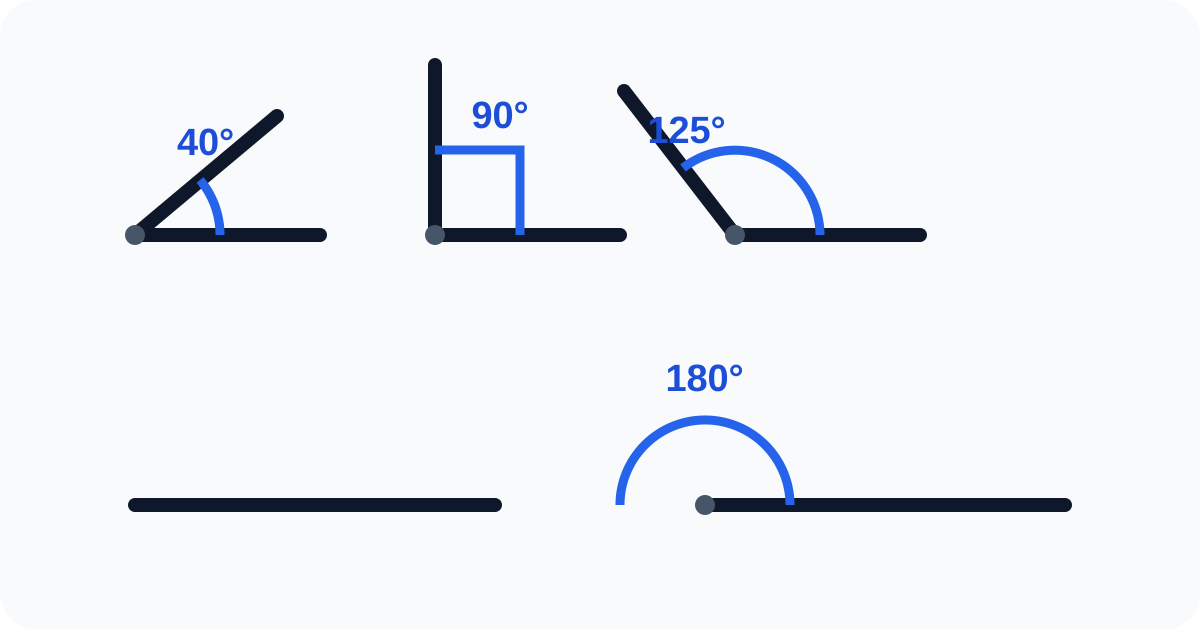
When you first start learning geometry, everything is in degrees. A circle is 360°, a right angle is 90°. It's intuitive and familiar.
But as you advance into trigonometry, calculus, or physics, suddenly radians appear. Why make things complicated? Why do we need a second unit for the same thing?
This guide breaks down the differences, explains why radians are essential for higher math, and shows you how to convert between them effortlessly. It also helps you recognize when degrees are the more practical choice, when radians are expected, and when it is worth checking a result with a measurement tool instead of relying on memory alone.
What is a Degree? (The "Human" Unit)
A degree (symbol: °) is a unit of angle measurement defined by dividing a full circle into 360 equal parts.
- Origin: Ancient Babylonians, who used a base-60 number system and estimated the year to be 360 days. (Learn more about the history of navigation angles).
- Best for: Navigation, construction, surveying, and everyday life.
- Key Values:
- Full Circle: 360°
- Straight Line: 180°
- Right Angle: 90°
Why we love it: 360 is a great number because it can be divided evenly by 2, 3, 4, 5, 6, 8, 9, 10, 12, etc. It makes mental math easy.
What is a Radian? (The "Mathematical" Unit)
A radian (symbol: rad) is defined using the radius of the circle.
Definition: One radian is the angle created when the arc length is equal to the radius of the circle.
Imagine taking the radius of a circle, bending it into a curve, and laying it along the edge of the circle. The angle that arc covers is exactly 1 radian.
- Origin: Pure mathematics. It relates the angle directly to the physical properties of the circle (radius and circumference).
- Best for: Calculus, physics, computer programming (most code libraries use radians).
- Key Values:
- Full Circle: 2π radians (≈ 6.28 rad)
- Straight Line: π radians (≈ 3.14 rad)
- Right Angle: π/2 radians (≈ 1.57 rad)
The Conversion Formula
Converting between the two is simple if you remember one fact: 180° = π radians
Degrees to Radians
Multiply by π / 180
Radians = Degrees × π / 180
Example: Convert 45° to radians. 45 × π / 180 = 45π / 180 = π / 4 radians
Radians to Degrees
Multiply by 180 / π
Degrees = Radians × 180 / π
Example: Convert π / 3 radians to degrees. π / 3 × 180 / π = 180 / 3 = 60°
Where You Will See Each Unit in Real Work
The difference is not just academic. Degrees and radians tend to show up in different environments, so learning to recognize the context saves a lot of confusion.
- Math and classroom geometry: Degrees are usually the first unit students see because they are easy to visualize on diagrams, clocks, and basic protractors. They are often the better unit when you are classifying angles or checking whether a sketch looks close to 30°, 45°, or 90°.
- Physics and higher math: Radians are preferred in trigonometry, calculus, wave motion, and angular velocity because many formulas are naturally defined in radians. If a formula includes sine, cosine, derivatives, or circular motion, radians are often the safer assumption until stated otherwise.
- Engineering, graphics, and programming: Degrees are common in drawings, CAD discussions, and practical communication, but many software libraries store or calculate rotation in radians internally. That is why engineers and developers often switch between the two rather than using only one system.
Common Mistakes When Switching Between Degrees and Radians
Most errors are not caused by hard math. They happen because the unit is not checked carefully.
- Using the wrong calculator or software mode: A calculator in radian mode will give the wrong result if you enter a degree value without converting it first.
- Typing a degree value as if it were radians: Entering
90into a system that expects radians does not mean a right angle. It means about 5157°. - Rounding too early: Converting π-based values into decimals too soon can introduce avoidable error, especially in multi-step physics or trigonometry problems.
- Measuring in degrees, then reporting in radians without conversion: A physical or on-screen protractor normally shows degree markings first, so the final unit still needs to be converted if the assignment or software expects radians.
Why Do Mathematicians Prefer Radians?
In advanced math (Calculus), formulas become much simpler with radians.
For example, if x is in radians:
- The derivative of sin(x) is simply cos(x).
If x were in degrees, the derivative would be:
- π / 180 cos(x)
That extra factor of π / 180 would appear in every single calculation, making equations messy and complicated. Radians are the "natural" unit for mathematics.
When Should You Check with a Tool?
If you are working from a photo, worksheet screenshot, PDF diagram, or design sketch, it is often smart to verify the angle instead of assuming the printed value is correct. A tool is especially useful when:
- the picture is small or crowded,
- you need to compare interior and exterior angles,
- you want to confirm whether a value is closer to 60° or π/3,
- or you need a clean record for homework, teaching notes, or design review.
If you want more background first, read our guide to angle types and classifications. If you want to practice making a rough judgment before measuring precisely, see how to estimate angles without tools.
Summary Table
| Angle | Degrees | Radians (Exact) | Radians (Decimal) |
|---|---|---|---|
| Zero | 0° | 0 | 0 |
| 30° | 30° | π/6 | 0.52 |
| 45° | 45° | π/4 | 0.79 |
| 60° | 60° | π/3 | 1.05 |
| Right Angle | 90° | π/2 | 1.57 |
| Straight | 180° | π | 3.14 |
| Full Circle | 360° | 2π | 6.28 |
Need to convert or verify angles quickly? Use our free Online Protractor to switch between degree and radian inputs and check your reading before you submit homework or document a measurement.
Sources and references
- SP 330 — Plane angles, solid angles and phase angles — National Institute of Standards and Technology
Ready to measure angles?
Try our free online protractor tool right now. No download required.
Use Online Protractor