Geometry in Architecture: Famous Angles and Structures
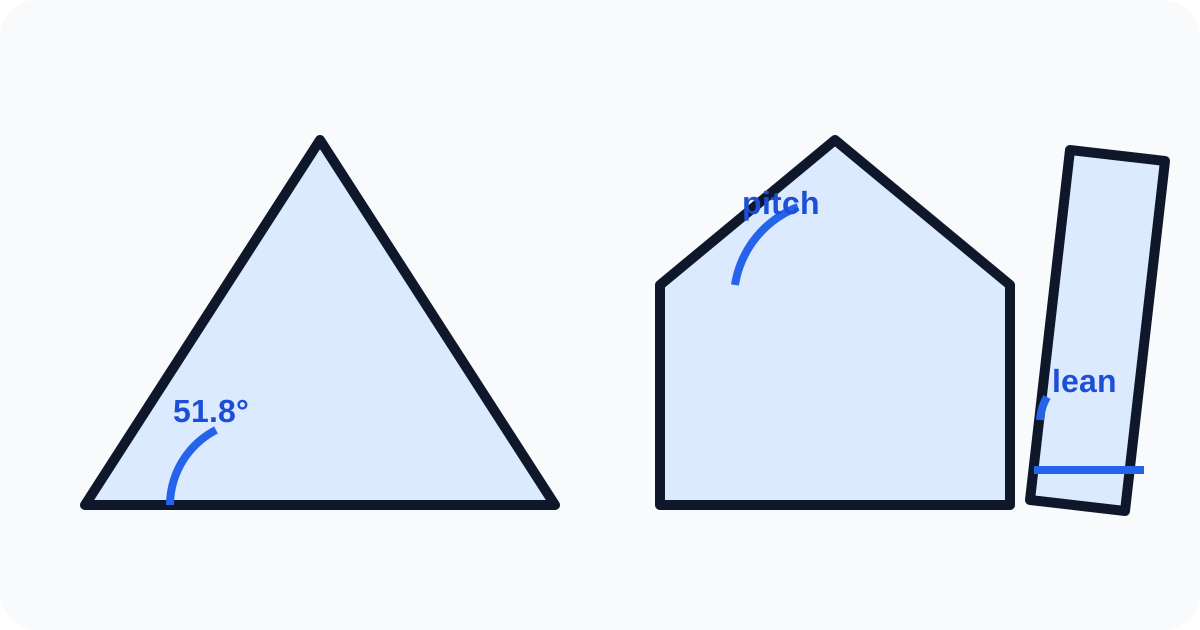
Architecture is frozen music, but it is also applied geometry. Every building you see is a collection of lines, shapes, and most importantly, angles. Without a deep understanding of angles, our skyscrapers would collapse, our bridges would fail, and our cathedrals would crumble. What makes architecture especially interesting is that these angles are not abstract—they affect drainage, stability, sunlight, circulation, and the way a space feels when you stand inside it.
Let's take a tour of some of the most famous structures in the world and uncover the secret angles that define them.
1. The Great Pyramid of Giza (Egypt)
The Great Pyramid is a useful case study in how a large structure can be described with a small set of measured lines. It was built in Egypt's Old Kingdom and its face slope is often reconstructed from surviving dimensions rather than read from an intact outer surface.
- Face slope: The UNESCO nomination material cited below gives the Great Pyramid's face angle as approximately 51° 52′.
- What the number does and does not prove: You can compare the reconstructed slant-height-to-half-base ratio with the golden ratio, but numerical similarity alone does not establish the builders' intent. Treat the relationship as a geometric observation, not a confirmed design motive.
2. The Leaning Tower of Pisa (Italy)
Not all famous angles were planned. The Leaning Tower of Pisa is famous precisely because its angle is wrong.
- The Lean: Published figures vary by survey date and by the reference used. For a learning exercise, mark the vertical reference first and record the source date beside any tilt value you use.
- The History: The tower began to lean during construction because of foundation and soil conditions. Later stabilization changed the measured tilt, which is why an undated number should not be presented as a permanent property.
- Lesson: Even a visually small angular deviation can become significant over the height of a structure.
3. The Pantheon (Rome)
The Pantheon is a temple to all the gods, famous for its massive concrete dome.
- The Perfect Sphere: The interior of the Pantheon is designed so that a perfect sphere with a diameter of 43.3 meters could fit inside.
- The Oculus: At the very top of the dome is an opening called the Oculus. The angle of the sun passing through this opening marks the time of day and the seasons, acting as a giant sundial.
- Structural form: The dome becomes thinner toward the top, while arches and supporting walls help transfer loads toward the foundation. A photograph can illustrate the visible geometry but cannot establish the internal load path by itself.
4. Modern Skyscrapers: The Shard (London)
Modern architecture often plays with angles to create striking visual effects. The Shard in London, designed by Renzo Piano, is a prime example.
- The Shape: It is an irregular pyramidal structure. Its sides slope inward at varying angles, meeting at the top but not touching, giving the impression of "shards" of glass.
- The Taper: The walls taper at an angle of approximately 6 degrees. This shape is not just for looks; it improves stability against wind loads and allows for more sunlight to reach the streets below compared to a rectangular block.
5. Angles You Can Observe in Everyday Buildings
You do not need to visit world-famous monuments to see architectural geometry in action. Once you start looking for angles, you will notice them almost everywhere.
- Roof pitch in houses: Steeper roofs help rain and snow move off faster, while lower slopes are more common in dry climates.
- Staircases and ramps: Their angle affects comfort, accessibility, and safety. A ramp that is too steep may save space, but it becomes harder to use.
- Window reveals and sun shading: Angled fins, louvers, and overhangs control glare and heat gain during different times of day.
- Bracing in bridges and halls: Repeated triangles and diagonal members spread loads and reduce unwanted movement.
How to Look at Architectural Angles More Carefully
If you want to train your eye, start with shapes that have a clear baseline and visible edges.
- Look for a horizontal or vertical reference first.
- Compare the structure with familiar benchmarks such as 30°, 45°, 60°, and 90°.
- Check whether you are judging the interior angle, exterior angle, or slope from the vertical.
- Be cautious with photos taken from below or at the side, because perspective can make an angle look steeper or flatter than it really is.
This is where rough estimation and exact measurement work well together. You might first estimate the angle of a roofline or support member, then confirm it with a digital tool if the drawing, photo, or assignment requires more confidence.
Why Angles Matter in Design
Architects use angles for three main reasons:
- Stability: Triangles (and their internal angles) are the strongest shape. You see them in trusses and bridges everywhere.
- Aesthetics: Angles guide the eye. Steep angles feel imposing and dramatic (like Gothic cathedrals), while shallow angles feel calm and grounded (like Prairie style homes).
- Function: Roof angles (pitch) are calculated based on local weather. In snowy areas, roofs need a steep angle (often >45°) so snow slides off. In dry, hot climates, flat or shallow roofs are common.
When Should You Measure Instead of Just Observe?
Visual observation is useful for learning, but it has limits. You should switch to precise measurement when:
- you are working from a technical drawing,
- you need to compare two similar slopes accurately,
- the image is distorted by perspective,
- or the angle affects a real decision in design, fabrication, or teaching.
If the goal is a reliable reading rather than a visual impression, use an online protractor to check the angle directly on a photo, plan, or screenshot.
Next time you walk through a city, look up. Try to estimate the angles you see. Is that roof 30 degrees or 45? Is that modern building leaning on purpose? The world is built on geometry.
Sources and references
- The Archaeological Sites of the Island of Meroe nomination dossier — UNESCO World Heritage Centre
- Astronomical Heritage thematic study — ICOMOS and International Astronomical Union
Ready to measure angles?
Try our free online protractor tool right now. No download required.
Use Online Protractor