From Sextants to GPS: A Brief History of Navigation Angles
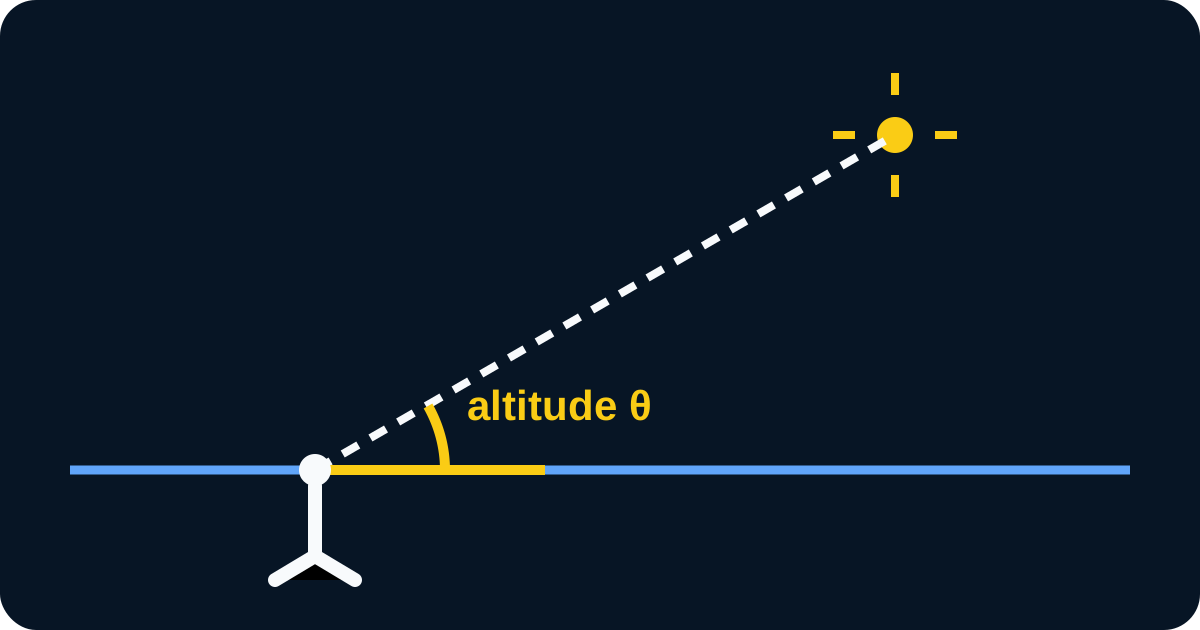
For thousands of years, to be at sea was to be lost. Sailors could follow the coastline, but once they ventured into the open ocean, they had no landmarks. Their only guide was the sky. In practice, this was not just a scientific problem. It affected whether a crew could stay on course, find an island, avoid dangerous coasts, and return home with food and trade goods.
The history of navigation is, at its core, the history of measuring angles. By measuring the angle between a celestial body (like the Sun or the North Star) and the horizon, sailors could calculate their position on the Earth. A small error mattered: one degree of latitude is about 111 kilometers (69 miles), so better angle measurement meant safer and more reliable travel.
1. The Ancient Method: Latitude by Polaris
In the Northern Hemisphere, the angle of the North Star (Polaris) above the horizon equals your latitude.
- If Polaris is 90° overhead: You are at the North Pole.
- If Polaris is on the horizon (0°): You are at the Equator.
- If Polaris is 45° up: You are at 45° North latitude.
This simple geometric fact helped northern sailors estimate where they were, while other navigators relied on the rising and setting positions of known stars. The idea was the same: compare the sky to the horizon and turn observation into location.
What made this difficult was not the geometry itself, but the environment. A ship moves, the horizon can be hazy, clouds hide the stars, and even a careful observer may read slightly different angles from one moment to the next.
2. The Cross-Staff (14th Century)
One of the earliest tools was the Cross-staff. It looked like a wooden cross. The navigator would hold the main staff to their eye and slide the cross-piece (transom) until the bottom edge touched the horizon and the top edge touched the star.
- Pros: Simple and cheap.
- Cons: You had to look directly at the sun (blinding!), and it was hard to hold steady on a rocking ship.
The cross-staff shows an important lesson in the history of navigation: a method can be mathematically correct but still hard to use well in real conditions.
3. The Astrolabe (Ancient Greece to Renaissance)
The Astrolabe was the "smartphone" of the ancient world. It was a complex metal disk that could predict the positions of the stars and sun. To measure an angle, a sailor would hang the astrolabe by a ring (to keep it vertical) and aim a sighting rule (alidade) at the star.
- Pros: Could do complex calculations.
- Cons: Wind made it sway, making accurate readings at sea nearly impossible.
4. The Sextant (1757): The Game Changer
The Sextant revolutionized navigation. It used mirrors to bring the image of the sun (or star) down to the horizon.
- Double Reflection: By looking through a telescope, the navigator could see both the horizon and the sun at the same time.
- Precision: It could measure angles with incredible accuracy, down to a fraction of a minute (1/60th of a degree). This allowed sailors to determine their latitude within a mile or two.
The sextant became especially powerful when combined with accurate timekeeping and nautical tables. It was no longer just about seeing an angle. It was about turning that angle into a usable position for charting a route across an ocean.
5. Why Historical Navigation Was Still Hard
Even with better instruments, navigators still had to deal with common sources of error:
- A moving deck: Waves changed the observer's position constantly.
- A poor horizon: Fog, glare, or heavy clouds made the reference line harder to trust.
- Human reading error: Small mistakes in reading or writing numbers could shift the final result significantly.
- Longitude problems: Latitude was often easier to estimate than longitude, especially before reliable marine chronometers became widespread.
6. Modern GPS: It's Still Geometry
Today, we use Global Positioning Systems (GPS) on our phones. But did you know GPS is still based on geometry?
Instead of measuring angles to stars, your phone measures the time delay of signals from satellites.
- Triangulation: By knowing the distance to at least four satellites, the system calculates your exact position in 3D space.
- The Geometry: It's essentially a high-tech version of the ancient method—finding your intersection point based on known reference points.
The tools changed, but the underlying idea did not. Navigation still depends on careful measurement, trusted reference points, and turning geometry into decisions.
What Modern Learners Can Take From This
This history is useful because it shows that angle measurement was never just classroom math. It solved a real problem under difficult conditions. If you want to understand the idea more concretely, try comparing a horizon line and a visible object in a diagram or photo, then estimate the angle before checking it with an online protractor.
Conclusion
From a wooden stick to a satellite network, the goal has remained the same: Where am I? The answer has always been found in mathematics. The next time you use Google Maps, remember the centuries of sailors who looked up at the stars and measured the angles to find their way home.
If you want to connect this history with practical angle reading today, continue with radians vs. degrees or practice by comparing visible lines in images before measuring them exactly.
Sources and references
- Time and Navigation timeline — Smithsonian National Air and Space Museum
- Skywatching FAQ — NASA Science
Ready to measure angles?
Try our free online protractor tool right now. No download required.
Use Online Protractor