Release Angles in Sports: A Practical Physics Guide
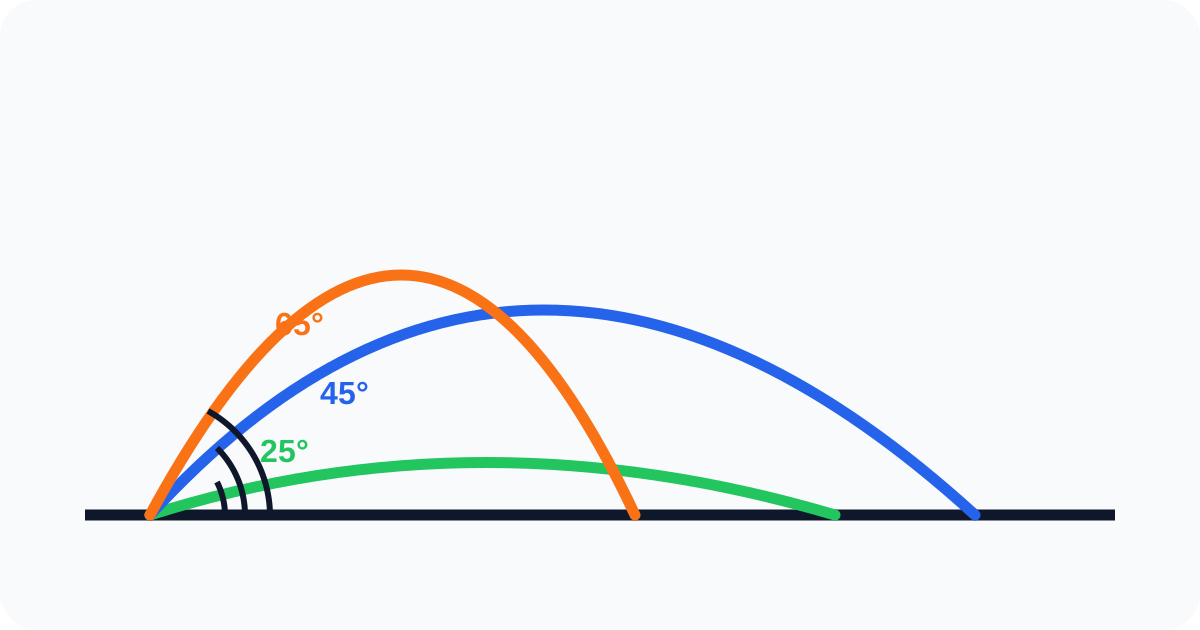
You might think sports are all about strength and speed. But ask any coach, and they will tell you it's also about mechanics. And mechanics is just a fancy word for physics and geometry.
In sports that involve a projectile—a ball, javelin, or discus—the angle of release is one factor that affects distance and accuracy. It must be interpreted together with speed, height, spin, drag, body mechanics, and the target.
What matters in real sports, though, is that an "optimal" angle is almost never one magic number you can copy in every situation. Release height, body position, spin, air resistance, fatigue, and pressure from defenders all change what works best.
The 45-Degree Result—and Its Limits
In the simplified textbook case—equal launch and landing heights, no air resistance, and fixed launch speed—the maximum-range angle is 45 degrees. Real sports rarely satisfy all four assumptions.
- Too High (> 45°): The ball goes high but wastes energy fighting gravity, landing short.
- Too Low (< 45°): The ball travels fast but hits the ground too soon.
However, we don't live in a vacuum. Air resistance changes everything.
Why the Best Angle Depends on the Situation
In sports, coaches and players care about the result of the whole movement, not just the launch angle by itself. A player may choose a lower or higher angle because:
- the release point is above the ground,
- the ball needs extra arc to clear a defender,
- spin changes the flight,
- the athlete is trading power for control,
- or the goal is accuracy rather than maximum distance.
This is why copying a famous athlete's angle without understanding the situation usually does not work.
1. Basketball: The Shooter's Touch
In basketball, the goal is not maximum distance but a controllable path into the hoop.
- Flat Shot: If you shoot flat (low angle), the hoop opening appears like an oval to the ball. The margin for error is tiny.
- High Arc: If you shoot with a high arc, the ball sees a full circle. There is no single entry or release angle that this guide can prescribe for every player. The useful arc depends on the player's height, release speed, defender pressure, shooting distance, and repeatability. A higher arc changes the entry geometry, but it may also demand more speed and control.
One common mistake is to think "higher is always better." In reality, the best shot is the one a player can repeat under game pressure, not just the one that looks most dramatic on video.
2. Soccer: Free-Kick Tradeoffs
When Cristiano Ronaldo or Lionel Messi takes a free kick, they aren't just kicking hard. They are calculating angles.
- Distance: A long goal kick generally uses a visibly higher launch path than a driven pass, but the useful angle changes with speed, wind and intended landing point.
- Curve and dip: Spin and ball contact change the path. A launch angle measured from one video frame does not by itself explain the later curve.
Soccer is a good example of why the same sport can have different "optimal" angles. A free kick over a wall, a driven cross, a long pass, and a goal kick all ask for different launch shapes.
Another easy mistake is trusting camera perspective too much. Broadcast angles can make a free kick look steeper or flatter than it really was. If you are studying technique, slow-motion replay from the side is much more useful than guessing from a front-facing highlight clip.
3. Golf: It's All in the Loft
Golf clubs are literally named after their angles (Loft).
- Driver: Typically has much less loft than a wedge and is intended for a lower launch family.
- Pitching Wedge: Has more loft and is designed for a higher, shorter shot family.
- The Swing Plane: The angle of your swing plane relative to the ground determines if you hit the ball straight, slice it, or hook it.
It also helps to remember that loft is not the same thing as actual launch angle. Strike quality, attack angle, wind, turf conditions, and spin rate all affect the final ball flight. That is why two golfers using the same club can produce very different results.
4. Javelin: Defying the 45° Rule
In javelin throwing, the simplified 45° result is not a universal prescription. The javelin's shape, attitude, aerodynamic forces, release height and the athlete's achievable speed all affect the useful release direction. A number taken from a single camera view should therefore be treated as an observed image angle, not a complete performance diagnosis.
This is a strong reminder that sports physics is rarely as simple as a schoolbook projectile problem. The object's shape, the athlete's approach speed, and aerodynamic lift can all push the real answer away from the textbook answer.
When Should You Estimate, and When Should You Recheck?
For casual watching or coaching cues, a rough visual estimate is often enough. But you should recheck with video, frame review, or a measuring tool when:
- you are comparing small technique changes,
- a coach wants repeatable data across multiple attempts,
- the camera angle may be misleading,
- or the athlete is trying to solve a specific consistency problem.
If you want a better feel for rough angle judgment first, see how to estimate angles without tools. If you need a cleaner way to think about angle families like acute and obtuse positions, review angle types classification.
Worked Example: Comparing Two Side-On Video Frames
Suppose a coach has two side-on frames from the same camera position and wants to compare the initial direction of a thrown ball.
- Use frames captured at the same resolution without stretching.
- Crop around the athlete and the first visible part of the ball path.
- Upload the first frame to the Online Protractor.
- Place the center at the estimated release point, one ray along a horizontal court or field reference, and the second along the initial path.
- Export or record the value, then repeat on the second frame with the same placement convention.
| Observation | Frame A | Frame B |
|---|---|---|
| Visible image angle | about 34° | about 38° |
| Camera position | Same side-on camera | Same side-on camera |
| Defensible conclusion | Frame B appears about 4° steeper | Not proof that one technique is better |
The numbers are an illustrative comparison, not measurements of a named athlete. If the camera moved, the lens zoom changed, or the action was not parallel to the image plane, the comparison loses strength. See the full accuracy and perspective guide before treating video geometry as physical motion data.
Conclusion
Next time you watch a game, look for the angles. The quarterback throwing a "Hail Mary," the tennis player hitting a lob, the diver entering the water—they are all doing split-second geometry calculations. Strength gets you in the game, but angles get you the win.
The important lesson is not that one number always wins. It is that good athletes learn which angle works best for a specific body, tool, and situation.
Sources and references
- Build and Launch a Foam Rocket — NASA Jet Propulsion Laboratory
- SP 330 — Plane angles, solid angles and phase angles — National Institute of Standards and Technology