No Protractor? No Problem! How to Estimate Angles Like a Pro
Imagine you are at a furniture store, trying to figure out if a corner desk will fit into your odd-shaped room. Or maybe you are sketching a design and need a quick 30-degree angle. You check your pockets—no protractor.
Don't worry. You can estimate angles with surprising accuracy using just your mind, a piece of paper, or a clock. The key is knowing when a quick estimate is good enough and when you should stop guessing and verify the result with a proper measurement.
1. The Clock Face Method
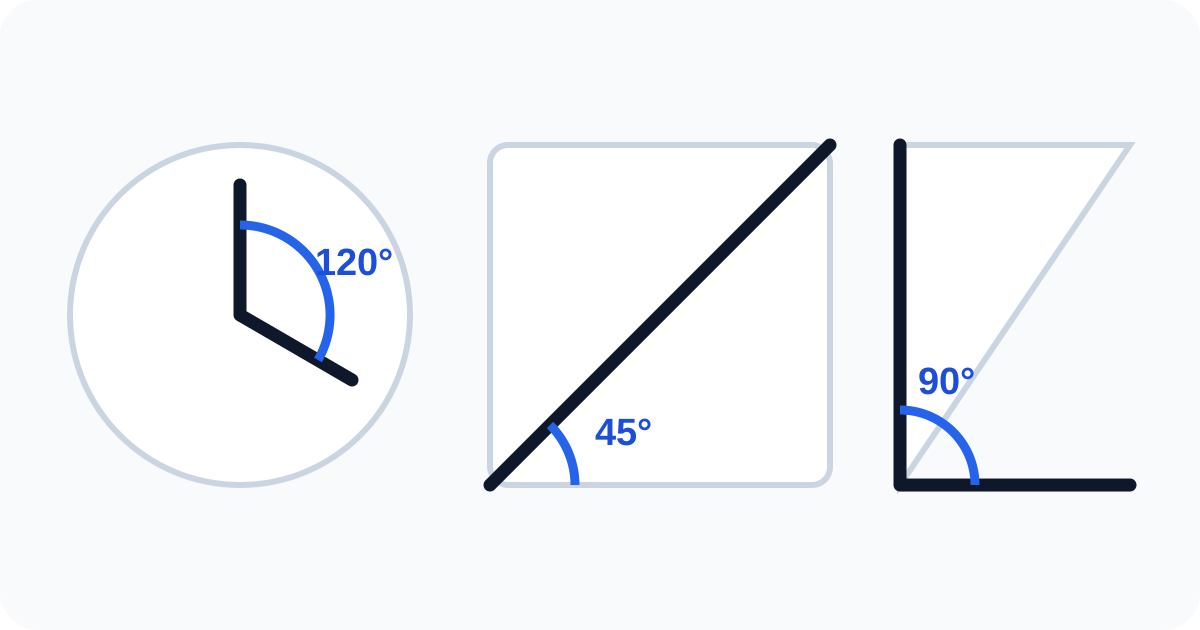
This is the easiest way to visualize angles because we look at clocks every day. A full circle is 360 degrees, and a clock has 12 hours. 360° / 12 = 30° per hour
Imagine the vertex of the angle is the center of the clock.
- 12:00 to 3:00: This is exactly 90 degrees (a right angle).
- 12:00 to 1:00: This is 30 degrees.
- 12:00 to 2:00: This is 60 degrees.
- 12:00 to 6:00: This is 180 degrees (a straight line).
Practical Use: Need a 45-degree angle? Imagine the time is 1:30. The hour hand is halfway between 1 and 2.
2. The Paper Folding Trick
If you have a sheet of paper (even a napkin), you have a precision tool.
- 90°: Any corner of a standard sheet of paper is a perfect 90-degree angle.
- 45°: Fold a corner diagonally so the top edge lines up with the side edge. The crease creates a perfect 45-degree angle.
- 22.5°: Fold that 45-degree angle in half again.
- 30° & 60°: This is slightly trickier but possible. Fold the paper in half lengthwise. Then, fold one corner of the original rectangle so it touches the center crease line. This creates a 60-degree angle at the bottom and a 30-degree angle at the top.
3. The "Pizza Slice" Visualization
Sometimes, food is the best teacher.
- 45°: A standard pizza is usually cut into 8 slices. One slice is exactly 360 / 8 = 45°.
- 60°: Think of a pie cut into 6 big slices.
- 30°: Think of a pizza cut into 12 thin party slices.
4. Body Mechanics (Proprioception)
Your body knows angles better than you think.
- 90°: Hold your arm out to the side and bend your elbow up like you are showing off your biceps. That’s a natural 90-degree angle.
- 45°: Stand with your feet shoulder-width apart. Turn one foot out so it points diagonally. That is roughly 45 degrees.
When Estimation Works Well
Estimation is most useful when speed matters more than perfect precision.
- Quick planning: Sketching a layout, checking whether furniture might fit, or blocking out a design idea.
- Classroom intuition: Building a feel for whether an angle looks acute, right, obtuse, or close to a familiar benchmark such as 30°, 45°, 60°, or 90°.
- Field decisions: Making rough visual judgments on site before you bring out exact tools.
- First-pass checking: Catching obvious mistakes before spending time on a full measurement.
When Estimation Is Not Enough
Some situations need more than a visual approximation.
- Homework or exams that require exact answers
- Construction, woodworking, or fabrication where small errors compound
- Physics or trigonometry problems where the exact value affects later steps
- Measurements taken from photos or screenshots with perspective distortion
- Cases where you need to tell the difference between nearby values, such as 58° and 60°
When to Switch Back to Exact Measurement
Even if estimation is the right starting point, you should return to a precise tool when:
- your estimate will be written down as a final answer,
- multiple angles need to stay consistent with one another,
- the diagram is crowded or the vertex is hard to see,
- or you need to compare interior and exterior readings confidently.
If you want to strengthen your visual intuition first, review angle types and classifications or compare common units in radians vs. degrees. If you need a reliable final check, use the online protractor rather than trusting a rough mental picture.
Conclusion
Tools are great, but estimation is faster. By training your brain to see clocks, pizza slices, and paper folds, you will develop an intuitive sense of geometry that serves you well in carpentry, drawing, or just parking your car. It is a practical first step, not a replacement for exact measurement. (Learn more about geometry in architecture).
When accuracy matters, do not rely on a mental estimate alone. Our free Online Protractor can provide a second on-screen reading, but image placement and perspective still limit the result; use a calibrated or source-specific method for critical work.
Sources and references
- SP 330 — Plane angles, solid angles and phase angles — National Institute of Standards and Technology
- Skywatching FAQ — NASA Science
Ready to measure angles?
Try our free online protractor tool right now. No download required.
Use Online Protractor