Complementary vs. Supplementary Angles: What's the Difference?
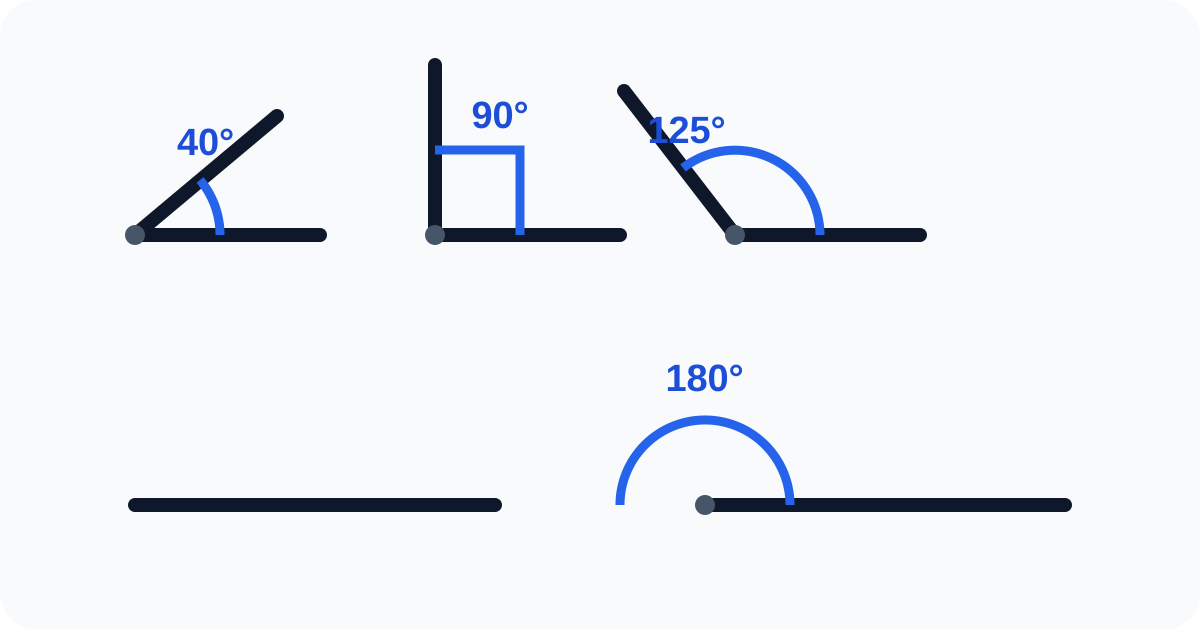
In geometry, angles often come in pairs. Two of the most common—and often confused—relationships are Complementary and Supplementary angles. You'll see these terms constantly in math homework, engineering diagrams, and design. Once you understand the difference, many diagrams become easier to read because you can quickly judge whether two angles should complete a corner or a straight line.
The definitions are simple, but remembering which is which can be tricky. This guide will give you the definitions, visual examples, and a foolproof memory trick to never mix them up again.
Complementary Angles (The "Corner" Pair)
Two angles are complementary if their measurements add up to exactly 90 degrees.
- The Math: Angle A + Angle B = 90°
- The Visual: Together, they form a perfect Right Angle (an "L" shape).
Examples
- 30° and 60° are complementary (30 + 60 = 90).
- 45° and 45° are complementary.
- 1° and 89° are complementary.
Real-world analogy: Think of a picture frame corner. If you cut the wood at two angles to make that 90° corner, those two cuts must be complementary.
Supplementary Angles (The "Straight" Pair)
Two angles are supplementary if their measurements add up to exactly 180 degrees.
- The Math: Angle A + Angle B = 180°
- The Visual: Together, they form a Straight Line.
Examples
- 100° and 80° are supplementary (100 + 80 = 180).
- 90° and 90° are supplementary.
- 135° and 45° are supplementary.
Real-world analogy: Open a book until it lies flat on the table. The two pages form a straight line (180°). If you lift one page slightly, the angle it makes with the table plus the angle it makes with the other page still relates to that flat line.
How to Recognize These Pairs in Diagrams
When you look at a figure, do not start with the names. Start with the total shape the pair creates.
- If the two angles together make a right angle, think complementary.
- If the two angles together make a straight line, think supplementary.
- If a diagram shows a square corner marker, the missing part of that 90° corner is the complement.
- If a line is cut by another ray, the two adjacent angles on that line often form a supplementary pair.
This is especially useful when one angle is labeled and the other is unknown.
The Memory Trick (Never Forget!)
How do you remember which is 90° and which is 180°? Use the "C" and "S" trick:
1. The "C" Trick
Complementary starts with C. You can turn the letter C into the number 9 (for 90) by drawing a line down.
- C -> Corner (90°)
2. The "S" Trick
Supplementary starts with S. You can turn the letter S into the number 8 (for 180) by connecting the ends.
- S -> Straight (180°)
Practice Problem
Let's test your knowledge.
Question: Angle A is 40°.
- What is its complement?
- What is its supplement?
Answer:
-
Complement: We need a total of 90°. 90° - 40° = 50°. So, the complement is 50°.
-
Supplement: We need a total of 180°. 180° - 40° = 140°. So, the supplement is 140°.
Common Confusions and Mistakes
These two ideas are easy to mix up, especially under time pressure.
- Confusing 90° with 180° totals: this is the most common mistake, especially when students remember the words but not the target sum.
- Assuming the angles must touch: two angles can be complementary or supplementary even if they are drawn separately. They only need the correct total.
- Mixing up adjacent supplementary angles with any 180° relationship: many adjacent pairs on a straight line are supplementary, but the idea is about the sum, not just the position.
- Estimating instead of checking: an angle that looks close to 90° may actually be 92°, which changes the conclusion.
If you are unsure whether a pair really adds to 90° or 180°, measure first instead of trusting the sketch.
Why Does This Matter?
Architects and carpenters use these pairs every day.
- Flooring: When laying floor tiles in a diamond pattern, cuts must be complementary to fit in the room corners.
- Roads: Civil engineers calculate banking angles on roads using supplementary relationships to ensure cars don't slide off during turns.
It also matters in classroom geometry, CAD sketches, construction plans, and image-based measurement. Knowing the relationship lets you solve for missing values faster and check whether a drawing makes sense before you calculate anything.
When Should You Measure Instead of Just Guessing?
Sometimes the relationship is obvious, but sometimes it only looks obvious. Use an actual measurement when:
- the drawing is rough or not to scale,
- the angle looks close to 90° or 180°,
- you need an exact value for a worksheet or design,
- or you want to confirm the result before converting between degrees and radians.
If needed, first classify the angle type, then measure it exactly with a protractor.
Conclusion
- Complementary = Adds to 90° (Corner)
- Supplementary = Adds to 180° (Straight Line)
Next time you see a pair of angles, just ask yourself: "Do they make a corner or a line?" That quick check often tells you whether to think 90° or 180° before you do any calculation.
Need to check an angle yourself? Use our free Online Protractor to measure any image instantly.
Sources and references
- SP 330 — Plane angles, solid angles and phase angles — National Institute of Standards and Technology
Ready to measure angles?
Try our free online protractor tool right now. No download required.
Use Online Protractor